Modules.
What happens when I don’t know what to write? I write that.
What happens when I feel uninspired? I watch a video about making stuff. Then go make something. Happened yesterday.
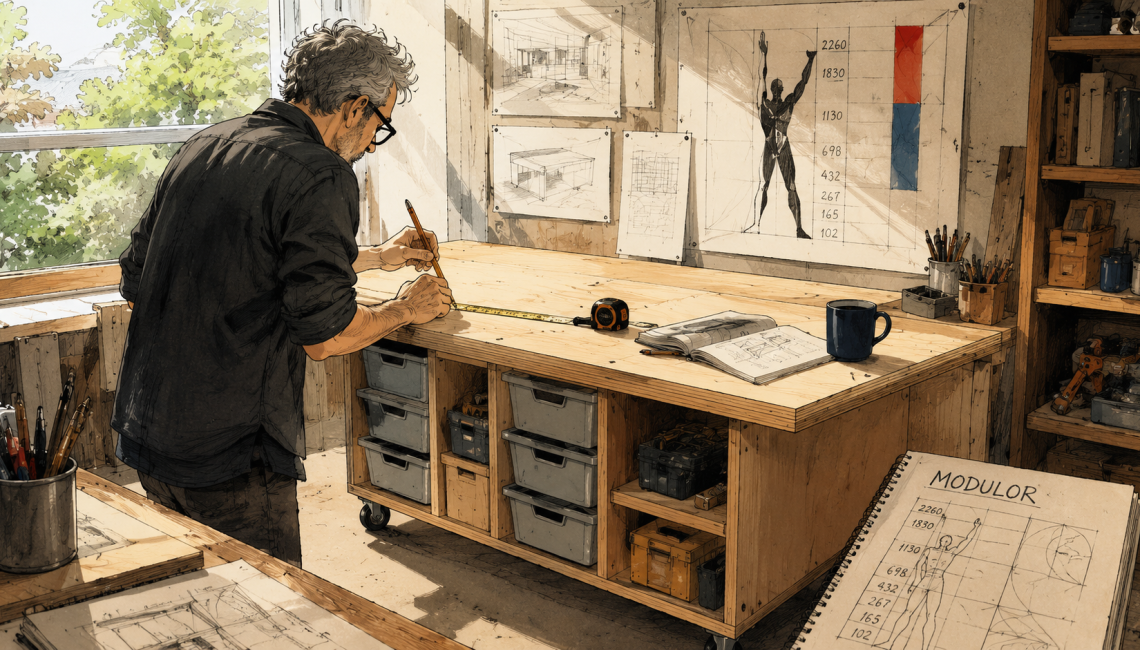
Last weekend I made a sturdy bench on wheels. The rickety thing I’d been using for the past year — plywood balanced on two plastic trestles, braced with screwed-on strips — had to go. The new one has five coats of matt varnish on a nice plywood top.
Quite by accident, it’s almost perfectly based on the Modulor Man.
The Modulor is a measuring system created by Le Corbusier to make buildings fit the human body. A set of dimensions drawn from the golden section. The idea was that buildings, rooms and furniture should feel natural and comfortable to use.
I don’t think it was an accident.
Well, it was. But hear me out.
I’ve been quietly obsessed with the Modulor for thirty-five years. I’ve read the two little square books Corbusier wrote about it in the 1950s over and over, and used the dimensions to guide buildings I design.
I never tell anyone.
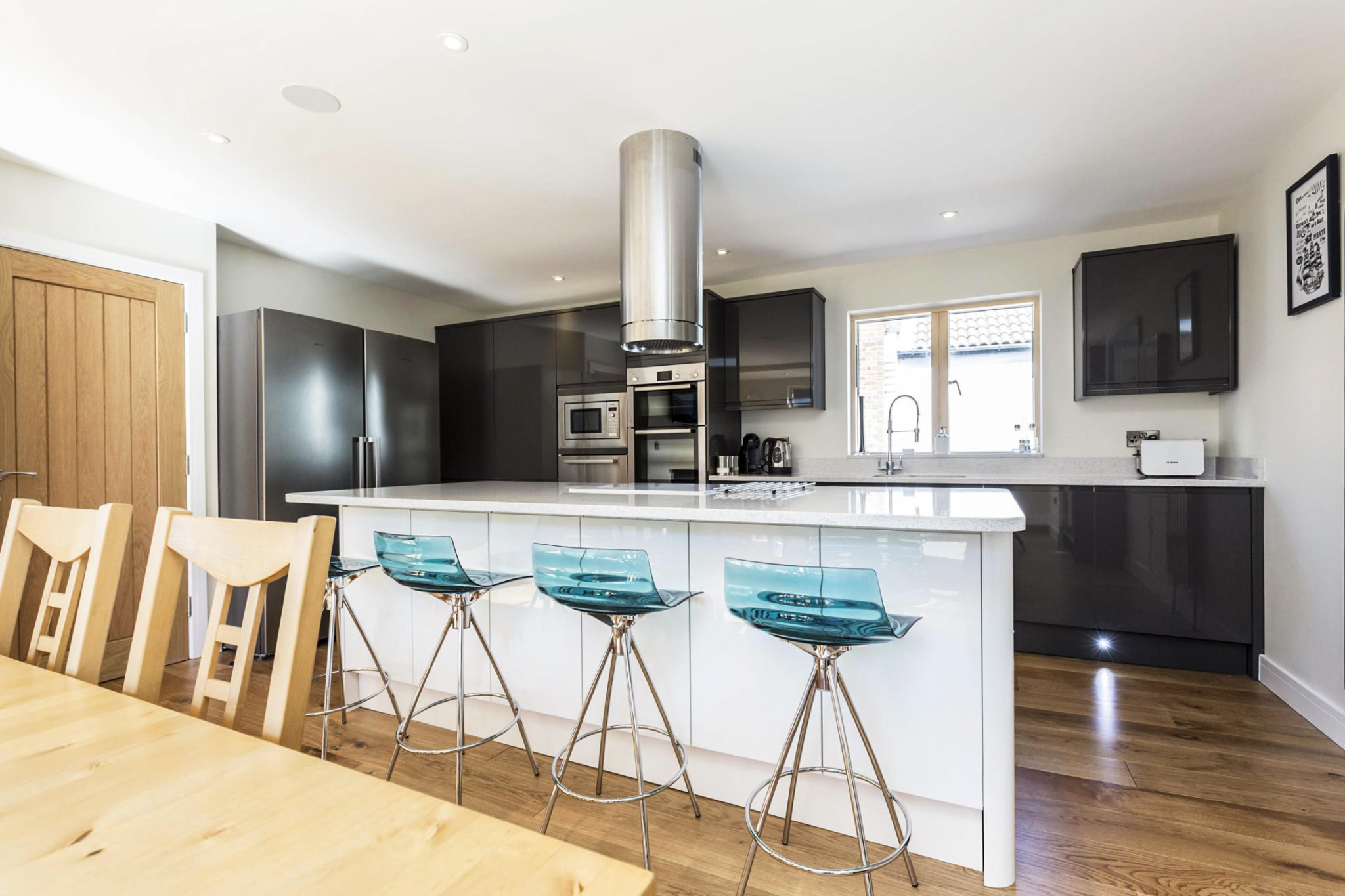
There’s a pair of houses in Devon, perfectly set out. Living rooms, 6,780mm square, 3,390mm high. The clients wanted at least 11-foot ceilings. 3,390mm is 11 feet and a fraction. There’s a government building somewhere I can’t name where every elevation — windows, doors, gutter line — is Modulor. And countless extensions and remodels where a tape measure would reveal its influence.
Back to the bench. I was measuring it this morning to see if it would fit in a different space. It’s modular in how it’s built — two cabinets on wheels, designed to slide in Euroboxes (more modules), and a heavy removable top.
“Huh, that’s interesting,” I said. To myself.
Practice compounds.
All the best

This Week’s Links:
A two-minute film on Le Corbusier’s Modulor system.
When does memorabilia become weird?
Bartenders Say ‘Overly Complex’ Cocktails Are Out—Here’s What Everyone Will Be Drinking This Summer
Main Image credit: Box work. (ChatGPT)