Thinking on your feet.
This week, my brain hurts. Not unpleasantly — but it hurts.
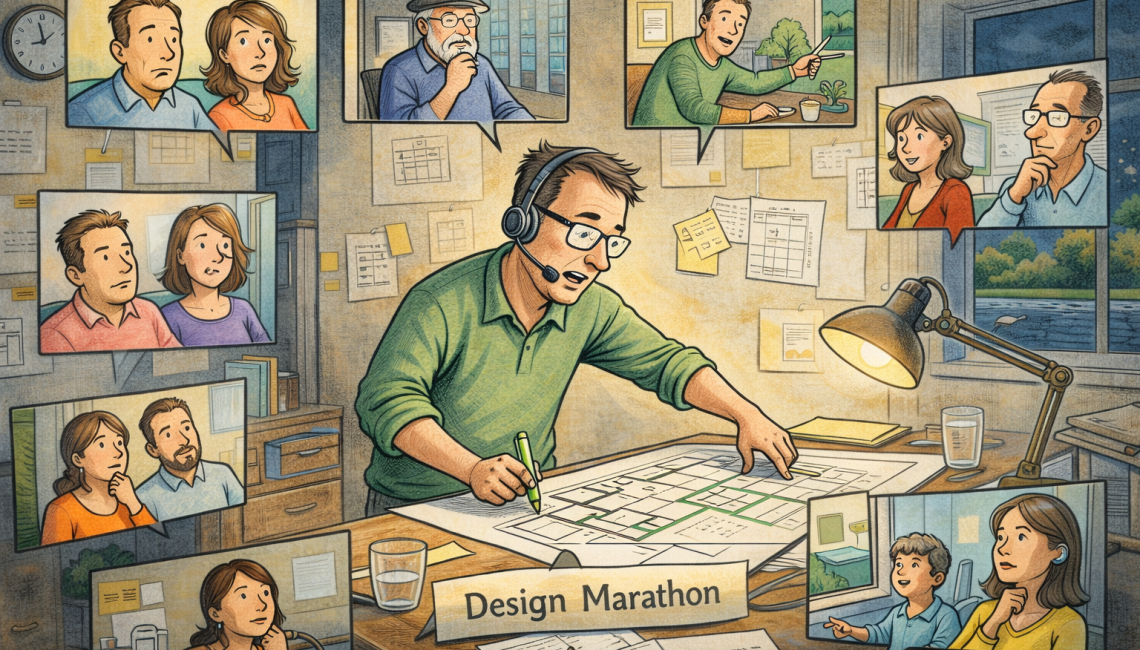
On top of everything else, I ran a second edition of my Design Marathon late into the evening. Eight back-to-back video calls, each one a different house, a different city, a different problem. Whether to extend or not. What it might cost. Whether the layout that’s been bothering someone for three years is actually fixable, and how.
It’s the architectural equivalent of being a taxi driver. They get in. I take them somewhere. They get out in a better place than where they started.
It’s a bit of a Magical Mystery Tour, mind you. The calls usually start with some version of “it feels like a bit of a problem house.” And then we start talking, and I start drawing, and things start to turn around.
As one participant put it this week: “you can tell you’re just riffing from the start — ideas come from ideas.” Which is exactly right. That’s what it feels like from the inside, too.
I’ve been doing versions of this for three or four years. But something has shifted. The Design Marathon is free. What’s evolved out of it is a paid service, the Home Improvement Workshop, which should be bookable within the next week or so. Same thinking, applied to a specific situation, one hour, done.
What’s interesting — and this week underlined it — is that the same problems exist everywhere. I started the week with a session in Sydney. Recent weeks have taken me virtually to Rome and Montreal. Different houses, different climates, different planning systems. Same issues: disconnected rooms, space in the wrong place, stairs positioned badly, no view of or access to the garden. The British semi doesn’t have a monopoly on being slightly wrong.
I came across a video this week in which an architect reflected on a proposed change to legislation—the idea that most building projects should require an architect. Protecting not just the title but the function. A mandatory design review before consents are stamped.
He had a point, in a way. Had something like that been in place for the past fifty years, we might see fewer of these disconnected rooms and badly positioned entrances that turn up in my calls week after week. Anyone could still design the extension — the builder, the engineer, or Bob down the pub — but an architect would review it before it got approved. Just the layout. The flow. The light. Where the doors go. Not the style, not the materials — just whether it actually works as a place to live.
In theory, it’s not a bad idea.
In practice, it’s a complete non-starter. There aren’t enough architects to review it. The red tape, the delays, the arguments about whose opinion counts — you can picture it immediately. More regulation is not what this country needs.
But here’s the thing. It is, more or less, what I’m doing in these sessions. Someone arrives with a house that doesn’t quite work. We look at it together. I tell them what I think, honestly, based on experience. They leave with a clearer picture of what’s possible and what to do next.
The difference is the government aren’t involved.
Have a good weekend.
All the best

This Week’s Links:
A extension to a Victorian house in east London
Protection of function for architects back on the government agenda
Looks like a fun ride – can’t see it taking off as a mode of transport, mind you.
Main Image credit: Te Design review, without the government. (ChatGPT)